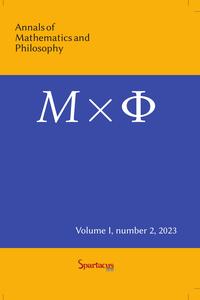
M×Φ

Annals of Mathematics and Philosophy

Volume I, number 2, 2023

Volume I, number 2, 2023
Cite this issue
M×Φ — Annals of Mathematics and Philosophy, 1(2), 2023.

Copied!

Articles

Much Badiou about Nothing: Productive Misreadings of Mathematical Ideas and Isiah Medina’s 88:88

Clint Enns pp. 1–23

Kepler's model for the solar system was constructed following the formal beauty of the Platonic Solids. Although not scientifically accurate, this model prompted many scientific advancements given that Kepler attempted to justify it using empirical evidence and, until that point in history, scientific research was mainly descriptive. In this article, I will argue that productive misreadings of mathematical ideas have the potential to lead to original concepts, and are not necessarily detrimental to the social sciences as physicist Alan Sokal (1998) and others contend. In particular, I will argue that French philosopher Alain Badiou's claim that "mathematics is ontology" is based on a mistake analogous to Kepler's — namely, that Badiou based the underlying structure for his ontological claims on set theory due to its perceived beauty. In spite of this, it will be shown that Badiou's conceptualization allows for novel ontological insight.

Enns, C. (2023). Much Badiou about Nothing: Productive Misreadings of Mathematical Ideas and Isiah Medina’s 88:88. M×Φ — Annals of Mathematics and Philosophy, 1(2), 1–23.

Copied!

Accepted proofs: Objective truth, or culturally robust?

Andrew Granville pp. 25–90

How does the mathematical community accept that a given proof is correct? Is objective verification based on explicit axioms feasible, or must the reviewer's experiences and prejudices necessarily come into play? Can automated provers avoid mistakes (as well as experiences and prejudices) to provide objective verification? And can an automated prover's claims be provably verified? We will follow examples of proofs that were found to be flawed, but then corrected (as the proof plan was sufficiently robust), as well as accepted "proofs" that turned out to be fundamentally wrong. What does this imply about the desirability of the current community standard for proofs? We will discuss whether mathematical culture is unavoidably part of the acceptance of a proof, no matter how much we try to develop foolproof, objective "proof systems".

Granville, A. (2023). Accepted proofs: Objective truth, or culturally robust?. M×Φ — Annals of Mathematics and Philosophy, 1(2), 25–90.

Copied!

Fregean abstraction in Zermelo-Fraenkel set theory: a deflationary account

Joel David Hamkins pp. 91–126

The standard treatment of sets and definable classes in first-order Zermelo-Fraenkel set theory accords in many respects with the Fregean foundational framework, such as the distinction between objects and concepts. Nevertheless, in set theory we may define an explicit association of definable classes with sets F 7→εF in such a way, I shall prove, to realize Frege's Basic Law V as a ZF theorem scheme, Russell notwithstanding. A similar analysis applies to the Cantor-Hume principle and to Fregean abstraction generally. Furthermore, because these extension and abstraction operators are definable, they provide a deflationary account of Fregean abstraction, one expressible in and reducible to set theory — every assertion in the language of set theory allowing the extension and abstraction operators εF, #G, αH is equivalent to an assertion not using them. The analysis thus sidesteps Russell's argument, which is revealed not as a refutation of Basic Law V as such, but rather as a version of Tarski's theorem on the nondefinability of truth, showing that the proto-truth-predicate "x falls under the concept of which y is the extension" is not expressible.

Hamkins, J. (2023). Fregean abstraction in Zermelo-Fraenkel set theory: a deflationary account. M×Φ — Annals of Mathematics and Philosophy, 1(2), 91–126.

Copied!

Virtues of Priority

Michael Harris pp. 127–153

Priority disputes in mathematics are not merely quarrels about dates. They reveal the standards by which mathematical communities distinguish a merely new statement from a contribution that counts as original, influential, or decisive. The dispute over the origin and naming of the Modularity Conjecture supplies a particularly illuminating case. A conjecture occupies a liminal position between idea and text: it can circulate informally, guide research for decades, and only later receive a precise statement. The competing attributions to Taniyama, Shimura, and Weil are therefore best understood not as mutually exclusive historical claims, but as appeals to different mathematical virtues. Taniyama’s 1955 problems exemplify the virtue of a cartesian insight: an imperfect but compelling imaginative leap linking elliptic curves and modular forms through Hasse’s conjecture and Hecke’s theorem. The case for Shimura combines Lang’s realist search for evidence with Shimura’s phenomenological accumulation of facts through the theory of modular and Shimura varieties. The case for Weil, as defended by Serre, lies in the precision added by the conductor and in making the conjecture numerically checkable, hence vulnerable to counterexample. The controversy persisted because these virtues neither exclude nor subsume one another. Its force is finally explained by the role of elliptic curves, the Birch-Swinnerton-Dyer Conjecture, and Fermat’s Last Theorem in shaping the collective desires and prevailing psychology of number theorists.

Harris, M. (2023). Virtues of Priority. M×Φ — Annals of Mathematics and Philosophy, 1(2), 127–153.

Copied!

Rota’s variation on the eidetic identity

Carlos Lobo pp. 155–188

Gian-Carlo Rota’s conception of mathematical identity is rooted in his reading of Husserl’s transcendental and eidetic phenomenology, and especially in the practice of eidetic variation. Beginning with Rota’s 1964 “conversion” to phenomenology, the paper reconstructs his account of identity as eidos: not a fixed form, but the contextual pole of an open-ended activity of identification, distinct from its changing facticities and disclosed only when one attends to the “how” of givenness rather than to the “what” alone. Carried over to mathematics, this account yields a strong thesis: a mathematical object such as the real line retains one and the same identity across radically different axiomatic presentations, none of which can exhaust it. Mathematical identities are consistent yet never complete, and every formal presentation presupposes a “pre-axiomatic grasp” of the object. Rota’s notion of cryptomorphism and his analyses of the Reynolds (averaging) operator, of quantum logic, of multisets and of probability theory are read as so many tests of a ternary relation between syntax, semantics and identity. The paper argues that this relation, and the eidetic structure it presupposes, are required to render the inner historicity of mathematics intelligible, and it situates Rota’s project within Husserl’s call for a reform of logic, against reductionism and objectivism.

Lobo, C. (2023). Rota’s variation on the eidetic identity. M×Φ — Annals of Mathematics and Philosophy, 1(2), 155–188.

Copied!

Tributes

Homage to Francis William Lawvere (1937–2023)

Gonzalo E. Reyes pp. 189–199

A tribute to the pioneering category theorist F. William Lawvere, recounting his intellectual trajectory and his profound contributions to the foundations of mathematics.

Reyes, G. (2023). Homage to Francis William Lawvere (1937–2023). M×Φ — Annals of Mathematics and Philosophy, 1(2), 189–199.

Copied!

Review Essays

Does Reason Have Limits? Review Essay on Stephen Budiansky, Journey to the Edge of Reason

Palle Yourgrau pp. 201–242

Stephen Budiansky has produced the second major biography of Kurt Gödel, after John Dawson's classic study. A comparison is made here between the two books, the latter, a more scholarly exercise — emphasizing Gödel's work — the former intended for a wider audience — emphasizing Gödel's life, in particular his private life. Budiansky, after so much has now been written about Gödel and the intellectual climate of the twentieth century, had an opportunity to reflect on just who Gödel was, on what he represented as one of the towering intellectual figures of not just the twentieth but of any century. Unfortunately, it will be argued, this is an opportunity lost. An attempt will be made, however, to do, in this regard, what Budiansky failed to do — to explain why Gödel to this day remains strangely misunderstood and not fully appreciated for who he really was. His time, it seems, has still not come.

Yourgrau, P. (2023). Does Reason Have Limits? Review Essay on Stephen Budiansky, Journey to the Edge of Reason. M×Φ — Annals of Mathematics and Philosophy, 1(2), 201–242.

Copied!